
INDEX
A
A year is a unit of time based on how long it takes the Earth to orbit the Sun.[1] In scientific use, the tropical year (approximately 365 solar days, 5 hours, 48 minutes, 45 seconds) and the sidereal year (about 20 minutes longer) are more exact. The modern calendar year, as reckoned according to the Gregorian calendar, approximates the tropical year by using a system of leap years.
The term 'year' is also used to indicate other periods of roughly similar duration, such as the lunar year (a roughly 354-day cycle of twelve of the Moon's phases – see lunar calendar), as well as periods loosely associated with the calendar or astronomical year, such as the seasonal year, the fiscal year, the academic year, etc.
Due to the Earth's axial tilt, the course of a year sees the passing of the seasons, marked by changes in weather, the hours of daylight, and, consequently, vegetation and soil fertility. In temperate and subpolar regions around the planet, four seasons are generally recognized: spring, summer, autumn, and winter. In tropical and subtropical regions, several geographical sectors do not present defined seasons; but in the seasonal tropics, the annual wetand dry seasons are recognized and tracked.
By extension, the term 'year' can also be applied to the time taken for the orbit of any astronomical object around its primary – for example the Martian year of roughly 1.88 Earth years.
The term can also be used in reference to any long period or cycle, such as the Great Year.[2]
A calendar year is an approximation of the number of days of the Earth's orbital period, as counted in a given calendar. The Gregorian calendar, or modern calendar, presents its calendar year to be either a common year of 365 days or a leap year of 366 days, as do the Julian calendars. For the Gregorian calendar, the average length of the calendar year (the mean year) across the complete leap cycle of 400 years is 365.2425 days (97 out of 400 years are leap years).[3]
In English, the unit of time for year is commonly abbreviated as "y" or "yr". The symbol "a" (for Latin: annus, year) is sometimes used in scientific literature, though its exact duration may be inconsistent.[citation needed]
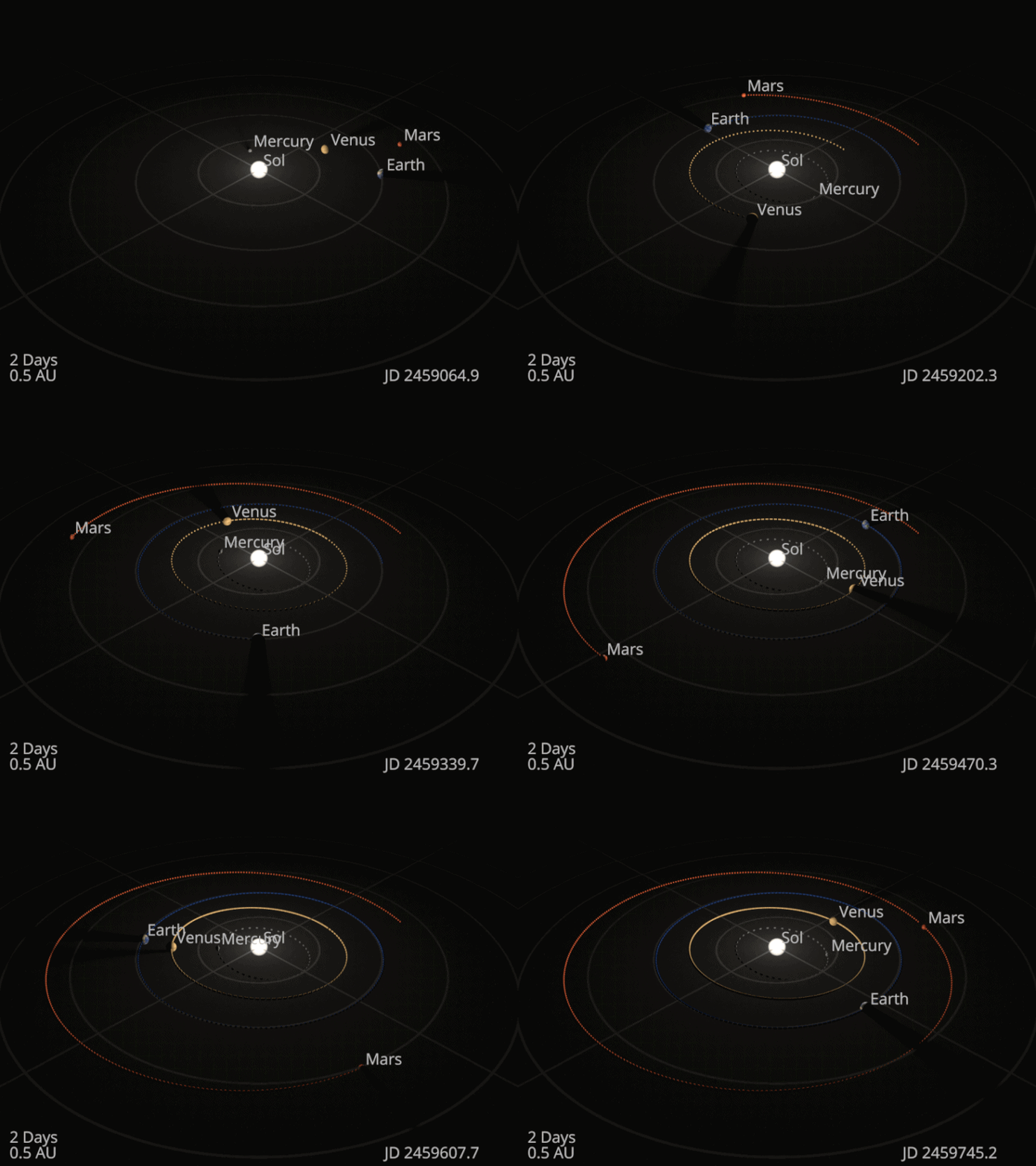
An animation of the inner Solar System planets' orbit around the Sun. The duration of the year is the time taken to go around the Sun.
A biotope is an area of uniform environmental conditions providing a living place for a specific assemblage of plants and animals. Biotope is almost synonymous with the term "habitat", which is more commonly used in English-speaking countries. However, in some countries these two terms are distinguished: the subject of a habitat is a population, the subject of a biotope is a biocoenosis or "biological community".[1]
It is an English loanword derived from the German Biotop, which in turn came from the Greek bios (meaning 'life') and topos ('place'). (The related word geotope has made its way into the English language by the same route, from the German Geotop.)
https://en.wikipedia.org/wiki/Biotope
MYTHOS GAMBO
Gambo ist der Name eines nicht identifizierten Kadavers eines großen Meerestieres.
https://de.wikipedia.org/wiki/Gambo
Die Kryptozoologie (altgriechisch κρυπτός kryptós „verborgen, geheim“, ζῷον zóon „Tier, lebendes Wesen“ und λόγος lógos „Lehre“) befasst sich mit Tierarten, für deren Existenz es nur schwache und zweifelhafte Belege gibt, beispielsweise in Legenden und in der Folklore, aus angeblichen Augenzeugenberichten oder Fußspuren sowie aus (meist verschwommenen) Fotos oder Filmen. Eine Tierart, die angeblich als Fabelwesen verkannt wird, bezeichnen Kryptozoologen als Kryptid und verbinden mit dieser Bezeichnung die Vermutung, dass die Art noch unentdeckt sei.
Von der wissenschaftlichen Zoologie wird die Kryptozoologie als Pseudowissenschaft eingeordnet;[1][2][3] im akademischen Bereich befassen sich Volkskunde und Mythologie mit solchen Wesen
Environmental studies is a multidisciplinary academic field which systematically studies human interaction with the environment. Environmental studies connects principles from the physical sciences, commerce/economics, the humanities, and social sciences, to address complex contemporary environmental issues. It is a broad field of study that includes the natural environment, the built environment, and the relationship between them. The field encompasses study in basic principles of ecologyand environmental science, as well as associated subjects such as ethics, geography, anthropology, public policy (environmental policy), education, political science (environmental politics), urban planning, law, economics, philosophy, sociology and social justice, planning, pollution control, and natural resource management.[3] There are many Environmental Studies degree programs, including a Master's degree and a Bachelor's degree. Environmental Studies degree programs provide a wide range of skills and analytical tools needed to face the environmental issues of our world head on. Students in Environmental Studies gain the intellectual and methodological tools to understand and address the crucial environmental issues of our time and the impact of individuals, society, and the planet. Environmental education's main goal is to instill in all members of society a pro-environmental thinking and attitude. This will help to create environmental ethics and raise people's awareness of the importance of environmental protection and biodiversity.
The natural environment or natural world encompasses all biotic and abiotic things occurring naturally, meaning in this case not artificial. The term is most often applied to Earth or some parts of Earth. This environment encompasses the interaction of all living species, climate, weather and natural resources that affect human survival and economic activity.[1] The concept of the natural environment can be distinguished as components:
In contrast to the natural environment is the built environment. Built environments are where humans have fundamentally transformed landscapes such as urban settings and agricultural land conversion, the natural environment is greatly changed into a simplified human environment. Even acts which seem less extreme, such as building a mud hut or a photovoltaic system in the desert, the modified environment becomes an artificial one. Though many animals build things to provide a better environment for themselves, they are not human, hence beaver dams and the works of mound-building termites are thought of as natural.
People cannot find absolutely natural environments on Earth, naturalness usually varies in a continuum, from 100% natural in one extreme to 0% natural in the other. The massive environmental changes of humanity in the Anthropocenehave fundamentally effected all natural environments including: climate change, biodiversity loss and pollution from plasticand other chemicals in the air and water. More precisely, we can consider the different aspects or components of an environment, and see that their degree of naturalness is not uniform.[2] If, for instance, in an agricultural field, the mineralogic composition and the structure of its soil are similar to those of an undisturbed forest soil, but the structure is quite different.
https://en.wikipedia.org/wiki/Natural_environment
The Earth's crust or lithosphere, is the outermost solid surface of the planet and is chemically, physically and mechanically different from underlying mantle. It has been generated greatly by igneous processes in which magma cools and solidifies to form solid rock. Beneath the lithosphere lies the mantle which is heated by the decay of radioactive elements. The mantle though solid is in a state of rheic convection. This convection process causes the lithospheric plates to move, albeit slowly. The resulting process is known as plate tectonics. Volcanoes result primarily from the melting of subducted crust material or of rising mantle at mid-ocean ridges and mantle plumes.
 Coral reefs have significant marine biodiversity.
Most water is found in various kinds of natural body of water.
An ocean is a major body of saline water and a component of the hydrosphere. Approximately 71% of the surface of the Earth (an area of some 362 million square kilometers) is covered by ocean, a continuous body of water that is customarily divided into several principal oceans and smaller seas. More than half of this area is over 3,000 meters (9,800 ft) deep. Average oceanic salinity is around 35 parts per thousand (ppt) (3.5%), and nearly all seawater has a salinity in the range of 30 to 38 ppt. Though generally recognized as several separate oceans, these waters comprise one global, interconnected body of salt water often referred to as the World Ocean or global ocean.[5][6] The deep seabeds are more than half the Earth's surface, and are among the least-modified natural environments. The major oceanic divisions are defined in part by the continents, various archipelagos and other criteria, these divisions are : (in descending order of size) the Pacific Ocean, the Atlantic Ocean, the Indian Ocean, the Southern Ocean and the Arctic Ocean.
A river is a natural watercourse,[7] usually freshwater, flowing toward an ocean, a lake, a sea or another river. A few rivers simply flow into the ground and dry up completely without reaching another body of water.
 Rocky stream in the U.S. state of Hawaii
The water in a river is usually in a channel, made up of a stream bed between banks. In larger rivers there is often also a wider floodplain shaped by waters over-topping the channel. Flood plains may be very wide in relation to the size of the river channel. Rivers are a part of the hydrological cycle. Water within a river is generally collected from precipitation through surface runoff, groundwater recharge, springs and the release of water stored in glaciers and snowpacks.
Small rivers may also be called by several other names, including stream, creek and brook. Their current is confined within a bed and stream banks. Streams play an important corridor role in connecting fragmented habitats and thus in conserving biodiversity. The study of streams and waterways in general is known as surface hydrology.[8]
 Lácar Lake, of glacial origin, in the province of Neuquén, Argentina
A lake (from Latin lacus) is a terrain feature, a body of water that is localized to the bottom of basin. A body of water is considered a lake when it is inland, is not part of an ocean and is larger and deeper than a pond.[9][10]
 A swamp area in Everglades National Park, Florida, US
Natural lakes on Earth are generally found in mountainous areas, rift zones and areas with ongoing or recent glaciation. Other lakes are found in endorheic basins or along the courses of mature rivers. In some parts of the world, there are many lakes because of chaotic drainage patterns left over from the last ice age. All lakes are temporary over geologic time scales, as they will slowly fill in with sediments or spill out of the basin containing them.
A pond is a body of standing water, either natural or human-made, that is usually smaller than a lake. A wide variety of human-made bodies of water are classified as ponds, including water gardens designed for aesthetic ornamentation, fish ponds designed for commercial fish breeding and solar ponds designed to store thermal energy. Ponds and lakes are distinguished from streams by their current speed. While currents in streams are easily observed, ponds and lakes possess thermally driven micro-currents and moderate wind-driven currents. These features distinguish a pond from many other aquatic terrain features, such as stream pools and tide pools.
Atmosphere, climate and weather
The atmosphere of the Earth serves as a key factor in sustaining the planetary ecosystem. The thin layer of gases that envelops the Earth is held in place by the planet's gravity. Dry air consists of 78% nitrogen, 21% oxygen, 1% argon, inert gasesand carbon dioxide. The remaining gases are often referred to as trace gases.[13] The atmosphere includes greenhouse gases such as carbon dioxide, methane, nitrous oxide and ozone. Filtered air includes trace amounts of many other chemical compounds. Air also contains a variable amount of water vapor and suspensions of water droplets and ice crystals seen as clouds. Many natural substances may be present in tiny amounts in an unfiltered air sample, including dust, pollen and spores, sea spray, volcanic ash and meteoroids. Various industrial pollutants also may be present, such as chlorine (elementary or in compounds), fluorine compounds, elemental mercury, and sulphur compounds such as sulphur dioxide (SO2).
The ozone layer of the Earth's atmosphere plays an important role in reducing the amount of ultraviolet (UV) radiation that reaches the surface. As DNA is readily damaged by UV light, this serves to protect life at the surface. The atmosphere also retains heat during the night, thereby reducing the daily temperature extremes.
Earth's atmosphere can be divided into five main layers. These layers are mainly determined by whether temperature increases or decreases with altitude. From highest to lowest, these layers are:
Within the five principal layers determined by temperature there are several layers determined by other properties.
 The retreat of glaciers since 1850 of Aletsch Glacier in the Swiss Alps (situation in 1979, 1991 and 2002), due to global warming
The dangers of global warming are being increasingly studied by a wide global consortium of scientists.[17] These scientists are increasingly concerned about the potential long-term effects of global warming on our natural environment and on the planet. Of particular concern is how climate change and global warming caused by anthropogenic, or human-made releases of greenhouse gases, most notably carbon dioxide, can act interactively and have adverse effects upon the planet, its natural environment and humans' existence. It is clear the planet is warming, and warming rapidly. This is due to the greenhouse effect, which is caused by greenhouse gases, which trap heat inside the Earth's atmosphere because of their more complex molecular structure which allows them to vibrate and in turn trap heat and release it back towards the Earth.[18] This warming is also responsible for the extinction of natural habitats, which in turn leads to a reduction in wildlife population. The most recent report from the Intergovernmental Panel on Climate Change (the group of the leading climate scientists in the world) concluded that the earth will warm anywhere from 2.7 to almost 11 degrees Fahrenheit (1.5 to 6 degrees Celsius) between 1990 and 2100.[19] Efforts have been increasingly focused on the mitigation of greenhouse gases that are causing climatic changes, on developing adaptative strategies to global warming, to assist humans, other animal, and plant species, ecosystems, regions and nations in adjusting to the effects of global warming. Some examples of recent collaboration to address climate change and global warming include:
 Another view of the Aletsch Glacier in the Swiss Alps, which because of global warming has been decreasing
A significantly profound challenge is to identify the natural environmental dynamics in contrast to environmental changes not within natural variances. A common solution is to adapt a static view neglecting natural variances to exist. Methodologically, this view could be defended when looking at processes which change slowly and short time series, while the problem arrives when fast processes turns essential in the object of the study.
 A rainbow is an optical and meteorological phenomenon that causes a spectrum of light to appear in the sky when the Sun shines onto droplets of moisture in the Earth's atmosphere.
Weather is a set of all the phenomena occurring in a given atmospheric area at a given time.[26] Most weather phenomena occur in the troposphere,[27][28] just below the stratosphere. Weather refers, generally, to day-to-day temperature and precipitation activity, whereas climate is the term for the average atmospheric conditions over longer periods of time.[29] When used without qualification, "weather" is understood to be the weather of Earth.
Weather occurs due to density (temperature and moisture) differences between one place and another. These differences can occur due to the sun angle at any particular spot, which varies by latitude from the tropics. The strong temperature contrast between polar and tropical air gives rise to the jet stream. Weather systems in the mid-latitudes, such as extratropical cyclones, are caused by instabilities of the jet stream flow. Because the Earth's axis is tilted relative to its orbital plane, sunlight is incident at different angles at different times of the year. On the Earth's surface, temperatures usually range ±40 °C (100 °F to −40 °F) annually. Over thousands of years, changes in the Earth's orbit have affected the amount and distribution of solar energy received by the Earth and influenced long-term climate.
Surface temperature differences in turn cause pressure differences. Higher altitudes are cooler than lower altitudes due to differences in compressional heating. Weather forecasting is the application of science and technology to predict the state of the atmosphere for a future time and a given location. The atmosphere is a chaotic system, and small changes to one part of the system can grow to have large effects on the system as a whole. Human attempts to control the weather have occurred throughout human history, and there is evidence that civilized human activity such as agriculture and industryhas inadvertently modified weather patterns.
 Atmospheric gases scatter blue light more than other wavelengths, creating a blue halo when seen from space.
 A view of Earth's tropospherefrom an airplane
 Lightning is an atmosphericdischarge of electricityaccompanied by thunder, which occurs during thunderstorms and certain other natural conditions.[12]a
https://en.wikipedia.org/wiki/The_Four_Seasons_(Vivaldi)
Musical expression is the art of playing or singing with a personal response to the music.[1]
At a practical level, this means making appropriate use of dynamics, phrasing, timbre and articulation to bring the music to life.[1] Composers may specify these aspects of expression to a greater or lesser extent in the notation of their musical score.
The nature of musical expression has also been discussed at a theoretical level throughout of the history of classical music. One common view is that music both expresses and evokes emotion, forming a conduit for emotional communication between the musician and the audience. This view has been present through most of musical history, though it was most clearly expressed in musical romanticism.[1] However, the role of emotion in music has been challenged on occasion by those like Igor Stravinsky who see music as a pure art form and expression as an irrelevant distraction.
In the Baroque and Classical periods of music, music (and aesthetics as a whole) was strongly influenced by Aristotle's theory of mimesis. Art represented the perfection and imitation of nature, speech and emotion.[1]: History before 1800
As speech was taken as a model for music, composition and performance in the Baroque period were strongly influenced by rhetoric. According to what has become known as the theory of affect, a musician was expected to stir feelings in his audience in much the same way as an orator making a speech in accordance with the rules of classical rhetoric. As a result, the aim of a piece of music was to produce a particular emotion, for instance joy, sadness, anger or calm. The harmony, melody, tonality, metre and structure of the music worked to this end, as did all the aspects under the performer's control such as articulation and dynamics.[2]
As Johann Joachim Quantz wrote in 1752,
The orator and the musician have, at bottom, the same aim in regard to both the preparation and the final execution of their productions, namely to make themselves the masters of the hearts of their listeners, to arouse or still their passions, and to transport them now to this sentiment, now that.[3]
The Four Seasons (Italian: Le quattro stagioni) is a group of four violin concerti by Italian composer Antonio Vivaldi, each of which gives musical expression to a season of the year. These were composed around 1718–1723, when Vivaldi was the court chapel master in Mantua. They were published in 1725 in Amsterdam in what was at the time the Dutch Republic, together with eight additional concerti, as Il cimento dell'armonia e dell'inventione (The Contest Between Harmony and Invention).
The Four Seasons is the best known of Vivaldi's works.[1][2] Though three of the concerti are wholly original, the first, "Spring", borrows patterns from a sinfonia in the first act of Vivaldi's contemporaneous opera Il Giustino. The inspiration for the concertos is not the countryside around Mantua, as initially supposed, where Vivaldi was living at the time, since according to Karl Heller[3] they could have been written as early as 1716–1717, while Vivaldi was engaged with the court of Mantua only in 1718.
They were a revolution in musical conception: Vivaldi represented flowing creeks, singing birds (of different species, each specifically characterized), a shepherd and his barking dog, buzzing flies, storms, drunken dancers, hunting parties from both the hunters' and the prey's point of view, frozen landscapes, and warm winter fires.
Unusual for the period, Vivaldi published the concerti with accompanying sonnets (possibly written by the composer himself) that elucidated what it was in the spirit of each season that his music was intended to evoke. The concerti therefore stand as one of the earliest and most detailed examples of what would come to be called program music—in other words, music with a narrative element. Vivaldi took great pains to relate his music to the texts of the poems, translating the poetic lines themselves directly into the music on the page. For example, in the second movement of "Spring", when the goatherd sleeps, his barking dog can be heard in the viola section. The music is elsewhere similarly evocative of other natural sounds. Vivaldi divided each concerto into three movements (fast–slow–fast), and, likewise, each linked sonnet into three sections.
 Title page of Vivaldi's Cimento dell'Armonia e dell'Invenzione, which included The Four Seasons

Vivaldi's arrangement is as follows:
A performance of all four concerti may take about 40–43 minutes. Approximate timings of the individual concerti:[4]
There is some debate as to whether the four concerti were written to accompany four sonnets or vice versa.[5] Though it is not known who wrote the accompanying sonnets, the theory that Vivaldi wrote them is supported by the fact that each sonnet is broken into three sections, each neatly corresponding to a movement in the concerto. Regardless of the sonnets' authorship, The Four Seasons can be classified as program music, instrumental music intended to evoke something extra-musical,[6] and an art form which Vivaldi was determined to prove sophisticated enough to be taken seriously.[7]
In addition to these sonnets, Vivaldi provided instructions such as "The barking dog" (in the second movement of "Spring"), "Languor caused by the heat" (in the first movement of "Summer"), and "the drunkards have fallen asleep" (in the second movement of "Autumn").
A new translation of the sonnets into English by Armand D'Angour was published in 2019.[8]
| Sonnet | Italian | English |
|---|---|---|
| Spring | Allegro | Allegro |
| Summer | Allegro non molto | Allegro non molto |
| Autumn | Allegro | Allegro |
| Winter | Allegro non molto | Allegro non molto |
 Bernardino Molinari, who made the first electrical recording of The Four Seasons in 1942.
The date and personnel on the first recording of The Four Seasons are disputed. There is a compact disc of a recording made by the violinist Alfredo Campoli taken from acetates of a French radio broadcast; these are thought to date from early in 1939.[9] The first proper electrical recording was made in 1942 by Bernardino Molinari; though his is a somewhat different interpretation from modern performances, it is clearly recognisable as The Four Seasons. Molinari's recording was made for Cetra, and was issued in Italy and subsequently in the United States on six double-sided 78s, in the 1940s. It was then reissued on long-playing album in 1950, and, later, on compact disc.[10]
The first American recording was made in the final week of 1947 by the violinist Louis Kaufman.[11] The recording was made at Carnegie Hall in advance of a scheduled recording ban effective 1 January 1948.[12] The performers were The Concert Hall Chamber Orchestra under Henry Swoboda, Edith Weiss-Mann (harpsichord) and Edouard Nies-Berger (organ).[13] This recording helped the re-popularisation of Vivaldi's music in the mainstream repertoire of Europe and America following on the work done by Molinari and others in Italy.[12] It won the French Grand Prix du Disque in 1950, was elected to the Grammy Hall of Fame in 2002, and was selected the following year for the National Recording Registry in the Library of Congress. Kaufman, intrigued to learn that the four concertos were in fact part of a set of twelve, set about finding a full score and eventually recorded the other eight concertos in Zürich in 1950, making his the first recording of Vivaldi's complete Op. 8.[14]
The ensemble I Musici has recorded The Four Seasons probably more often than any other established musical group to date: The debut recording in 1955 with Felix Ayo; again with Ayo in 1959, this time in stereo — the very first stereo recording of the work; subsequent recordings featuring Roberto Michelucci (1969), the highly acclaimed 1982 recording with Pina Carmirelli, Federico Agostini (1988), Mariana Sîrbu (1995), Antonio Anselmi (2012) and Marco Fiorini (2021). There is also a video recording of The Four Seasons performed by I Musici in Antonio Vivaldi's hometown of Venice, filmed by Anton van Munster in 1988.[15]
The 1969 Argo recording by the Academy of St. Martin-in-the-Fields conducted by Neville Marriner and featuring the soloist Alan Loveday sold over half a million copies; it became the ensemble's first gold record.[16]
I Solisti di Zagreb, under the baton of Antonio Janigro with Jan Tomasow as violin soloist and Anton Heiller on harpsichord, followed in 1957 on the Vanguard label, further reissued under the Philips and other labels. Wilfrid Mellers, an English music critic, musicologist and composer wrote of this performance, "the soloists phrase their lyricism beautifully."[citation needed] John Thornton wrote about this recording, "Here is matchless ensemble playing, topped by Tomasow's secure playing. Janigro reveals his talent for conducting, which competes with his considerable talent for cello playing."[17]
Ivan Supek wrote of this recording:
I will attempt to convey to you how much this performance means to me, and might mean to you, as well. My first encounter with the records took place almost thirty years ago, when "our" Antonio revealed to me the true significance of the piece of another great Antonio, his famous namesake, whose Le Quattro Staggioni I could hardly listen any more because of the "grand", actually too grand, performances usual at that time, let alone enjoy them. What a change it was – a window into a new world; music is fast, precise and true to life, the intonation is correct, the continuo appropriate, and the violin of beautiful sound in fitting correlation with the Zagreb Soloists. The self-assured and fine tone of Jan Tomasow's solo violin relates perfectly with the Soloists; the entire performance is impregnated with the spirit of Janigro's perfectionism, leaving the music and its soul fully exposed. It had been for a long time the only performance I could listen to. Only during [the] last decade some new kids, playing authentic instruments, have offered to me similar pleasure and insights into the music of Antonio Vivaldi and, to my great pleasure, Janigro's performance is no longer the only choice for me. In my opinion, this also shows how Janigro's performance in cooperation with the Zagreb Soloists was far ahead its time, as corroborated by Igor Stravinsky, who claimed that it was the most beautiful performance of Le Quattro Staggioni he had ever heard, a statement which I only recently learned about. No wonder, since such “bareness” and precision of Janigro's interpretation must have appealed to him. It was much later that I discovered the excellence of the recording as well. At that time, the Zagreb Soloists were recording for Vanguard, mostly in Vienna at various locations, and this particular recording was made in 1957 at Rotenturmstrassaal. Recording was produced by Seymour Solomon, chief producer of the entire edition, who would personally come from the USA to oversee every recording to be made by the Zagreb Soloists, whereas the Vanguard branch in Vienna "Amadeo" was in charge of the organisation. (My gratitude to one of the founders of the Zagreb Soloists, Mr. Stjepan Aranjoš, for providing me with some important insights). Janigro was a perfectionist, often rather merciless, not only in matters of music but also in terms of the sound, so he participated directly and intensely in [the] recording process, which was quite uncommon at that time. All that great care, by all participants in the project, is amply reflected in the recording itself, resulting in an airy performance of appropriate spaciousness and extension, with only occasional “congestion” of high tones in forte sections.[18]
Paul Shoemaker wrote about this recording:
Nothing I have heard changes my view that the best Seasons ever was performed by Jan Tomasow and I Solisti di Zagreb and beautifully recorded by Vanguard at the very beginning of the stereo era. If you have almost every other version of the Seasons, you'll want this one, too. If money and space are no obstacle, it might be worth having.[19]
Nigel Kennedy's 1989 recording of The Four Seasons with the English Chamber Orchestra sold over three million copies worldwide, becoming one of the best-selling classical works ever.[20][21] The marketing of Kennedy's record was described as "the first time that a classical artist had been given the full pop marketing treatment", with a promotional single, and advertisements on billboards, TV and radio.[20]
Gil Shaham and the Orpheus Chamber Orchestra recorded The Four Seasons as well as a music video for the first movement of "Winter" that was featured regularly on The Weather Channel in the mid-1990s.
Surround sound versions of the piece have been issued on Super Audio CD by Richard Tognetti, Pinchas Zukerman, Jonathan Carney and Rachel Podger.
The World's Encyclopedia of Recorded Music in 1952 cites only two recordings of The Four Seasons – by Molinari and Kaufman. By 2011, approximately 1,000 recorded versions have been made since Campoli's in 1939.[citation needed]
In 2009, all four concertos were arranged for piano by pianist Jeffrey Biegel.
In 2023, Gramophone Magazine named La Serenissima's recording of the Manchester version of The Four Seasons as "potentially the most streamed interpretation ever."[22] with over 165 million streams on Spotify alone.
Classical musicians have sought to distinguish their recordings of The Four Seasons, with historically informed performances, and embellishments, to the point of varying the instruments and tempi, or playing notes differently from the listener's expectation (whether specified by the composer or not).[23] It is said that Vivaldi's work presents such opportunities for improvisation.[24] Many period-based ensembles have recorded The Four Seasons, including La Serenissima under the direction of Adrian Chandler who recorded the Manchester version of The Four Seasons, The English Concert under the direction of Trevor Pinnock, the Academy of Ancient Music under the direction of Christopher Hogwood and Europa Galante under the direction of Fabio Biondi.
The Four Seasons was voted #67 in the Classic FM Hall of Fame. Three of the four concerti were included in the Classic 100 Concerto listing.
Derivative works of these concerti include arrangements, transcriptions, covers, remixes, samples, and parodies in music — themes in theater and opera, soundtracks in films (or video games), and choreography in ballet (along with contemporary dance, figure skating, rhythmic gymnastics, synchronized swimming, etc.) — either in their entirety, single movements, or medleys. Antonio Vivaldi appears to have started this trend of adapting music from The Four Seasons, and since then it has expanded into many aspects of the performing arts (as have other instrumental & vocal works by the composer). This contest between harmony and invention (as it were) now involves various genres around the world:
1726 (or 1734)
1727 (or 1730, 1731)
1739
1765
1775
1969
1970
1972
1976
1978
1981
1982
1984
1987
1990
1993
1995
1997
1998
1999
2000
2001
2003
2004
2005
2007
2008
2009
2010
2011
2012
2013
2014
2015
2016
2019
2021
2022
2023
2025
A garden is a planned space, usually outdoors, set aside for the cultivation, display, and enjoyment of plants and other forms of nature. The single feature identifying even the wildest wild garden is control. The garden can incorporate both natural and artificial materials.[1]
Gardens often have design features including statuary, follies, pergolas, trellises, stumperies, dry creek beds, and water features such as fountains, ponds (with or without fish), waterfalls or creeks. Some gardens are for ornamental purposes only, while others also produce food crops, sometimes in separate areas, or sometimes intermixed with the ornamental plants. Food-producing gardens are distinguished from farms by their smaller scale, more labor-intensive methods, and their purpose (enjoyment of a pastime or self-sustenance rather than producing for sale, as in a market garden). Flower gardens combine plants of different heights, colors, textures, and fragrances to create interest and delight the senses.[2]
The most common form today is a residential or public garden, but the term garden has traditionally been a more general one. Zoos, which display wild animals in simulated natural habitats, were formerly called zoological gardens.[3][4] Western gardens are almost universally based on plants, with garden, which etymologically implies enclosure, often signifying a shortened form of botanical garden. Some traditional types of eastern gardens, such as Zen gardens, however, use plants sparsely or not at all. Landscape gardens, on the other hand, such as the English landscape gardens first developed in the 18th century, may decide to omit flowers altogether.
Landscape architecture is a related professional activity with landscape architects tending to engage in design at many scales and working on both public and private projects.[5]
https://en.wikipedia.org/wiki/Garden_of_Eden